
Before submitting a form or picking up the phone, the first question to settle is whether the person you are contacting is legitimate. A club affiliated with a federation has a verifiable affiliation number, a president registered with the local authorities and, in most cases, an instructor with a professional licence. Checking these details before sharing personal information helps avoid unpleasant surprises, especially when a minor or a health concern is involved.
Verifying a club contact’s credentials: what to check before getting in touch
A non-profit sports club is required to register its board with the local authorities. Its RNA number (National Register of Associations) and federation affiliation number are two details you can check online or request directly. If the person who responds cannot provide either, proceed with caution.
For minors, a standard training agreement sets out the club’s obligations regarding medical monitoring, schooling and reporting channels. For example, the standard training agreement of the French Ice Hockey Federation, approved by decree on 18 July 2025, details these provisions. Although this framework is specific to ice hockey, it illustrates a broader principle: always ask who the relevant contacts are and what safeguards are in place for the pathway offered to a young athlete.
When you contact the Sport Essex team, the same principles apply: a clearly identified form, a named contact and a response that specifies the exact scope of the support offered.
For health-related enquiries (returning to exercise after an injury, a chronic condition or adapted physical activity), check whether the club has an instructor trained in adapted physical activity or works with a sport and health network. Even a highly capable volunteer is not qualified to advise participants on medical matters simply because they have experience on the field.

Maisons Sport-Santé and sport and health networks: underused resources for contacting a club
Maisons Sport-Santé do more than hand out brochures. Their services include welcoming visitors, providing information, offering guidance and connecting people with recognised clubs. Some also offer an initial assessment and tailored follow-up. However, services vary from one organisation to another: asking exactly what services are available and which clubs the Maison recommends should be part of your first conversation.
In Île-de-France, the Prescri’forme programme brings together an advice platform, resource centres and clubs approved to provide adapted physical activity. This kind of regional network can help you find a more suitable match than a federation directory, particularly if you have a prescription. It is not a standardised service available throughout France: each region has its own programmes.
Going through a Maison Sport-Santé offers a practical advantage when it comes to the checks mentioned above. They refer people to organisations that have already been identified and listed, reducing the risk of dealing with someone who is not qualified.
Questions to ask when first contacting a sports club
Your first conversation, whether by phone, email or online form, should cover specific points. Many people ask only about schedules and fees, even though other factors affect the quality of the personalised support on offer.
- Type of membership licence offered: recreational, competitive or coaching. Licence categories determine which activities are available and what insurance conditions apply. A club that does not distinguish between these categories may lack administrative rigour.
- Main instructor’s qualifications: professional licence, federation diploma or training in adapted physical activity. For a minor, ask for the name and qualifications of the designated instructor.
- Whether the club accepts Pass’Sport: eligibility depends on specific criteria, and the club must participate in the scheme. Check the official requirements for the current season before relying on this support.
- Trial arrangements and commitment period: some clubs require an annual commitment from the time of registration, while others offer taster sessions. The answer can reveal how flexible their support is.
- Dedicated contact for administrative or health-related questions: in medium-sized organisations, one person often handles the office, reception and follow-up. Finding out who that is from the outset makes future communication easier.
If the club cannot answer these questions clearly, take it as a warning sign. Personalised support requires a basic level of administrative organisation.
Contact channels: choose the right one for your enquiry
An online form is the easiest channel to keep a record of. It creates a timestamp, lets you attach documents (such as a medical certificate or Pass’Sport eligibility document) and provides a written record that can be used if a dispute arises. For routine enquiries about schedules, fees or available sessions, it is the most efficient option.
Phone calls are better for enquiries that require a real-time conversation, such as a disability, returning to exercise after an injury or registering a minor with school-related constraints. Prepare a list of specific questions before calling to avoid forgetting anything and to help you assess the quality of the answers.
Social media (the club’s Facebook page or Instagram account) is mainly useful for assessing how active the organisation really is: how often it posts, whether it shares training photos and whether it reports competition results. We advise against sharing personal information or administrative documents there. These platforms guarantee neither confidentiality nor the identity of the person you are speaking to.
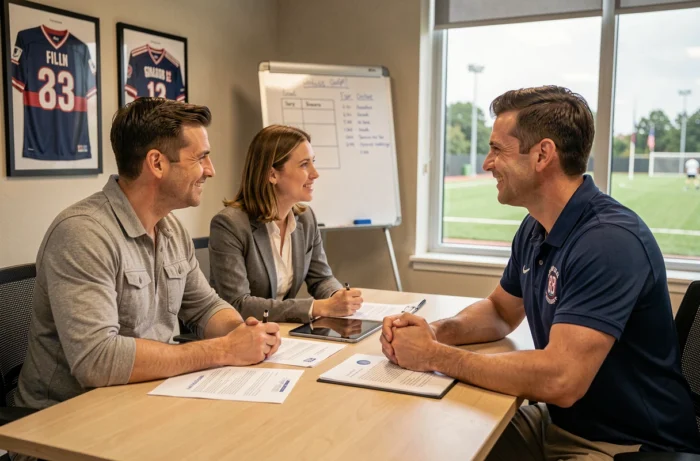
Meeting in person at an associations fair or open day is still the most reliable way to assess the coaching. Watching a training session, talking to other members and checking the required notices (qualifications, insurance and internal rules) can tell you things no form will.
A club that offers several ways to get in touch and responds within a reasonable timeframe demonstrates the level of organisation needed to provide high-quality personalised support. By contrast, an organisation reachable only through social media direct messages, with no postal address or visible phone number, should be checked carefully before you sign up.