
A frying pan that starts sticking after three months, a knife that crushes tomatoes instead of slicing them, a saucepan handle that burns your fingers: we’ve all experienced these frustrations that turn making dinner into a chore. The problem rarely lies with the cook. It’s usually the kitchen equipment, poorly chosen or bought as a set without considering how it will actually be used.
Cookware and hob compatibility: the pitfall you discover too late
You move house, switch from a gas cooker to an induction hob, and half your pans become unusable. Induction only heats cookware with a ferromagnetic material in its base. In practice, there’s a simple test: if a magnet sticks to the bottom of the pan, it’s compatible.
This detail has a direct impact on your budget. Rather than replacing an entire cookware set, you can replace only the incompatible pieces and keep the ones that still work. Before buying any new equipment, check that it’s compatible with your heat source to avoid unnecessary spending.
In its Panel Elecdom study, conducted from July 2023 to July 2024, ADEME measured the energy consumption of household appliances in around a hundred homes. The results confirm that consumption varies considerably depending on the appliance and how it is used. Comparing equipment of the same type and checking energy use per cycle, when available, provides a more reliable benchmark than the annual averages found all over the internet.
For more information about kitchen utensils and category-by-category comparisons, Yummy Blog’s kitchen equipment guide breaks down the technical features of each item.

Kitchen knives: three blades are all you need
Six- or eight-knife sets may seem like good value for money. In practice, you’ll use two or three, while the rest sit in a drawer.
- A paring knife (8 to 10 cm blade) for peeling, trimming vegetables and other precise tasks.
- A chef’s knife (around 20 cm blade) for slicing, chopping and mincing. It’s the ultimate all-purpose knife—the one you’ll reach for ten times during a meal.
- A serrated bread knife, because no other blade can cut through a crust properly without crushing the crumb.
Three well-sharpened knives are better than a full set of mediocre blades. A sharp knife requires less force, reducing the risk of slipping and cutting yourself. To keep the edge sharp, regular use of a honing steel or fine-grit whetstone can extend the life of your blades by several years.
Which blade material should you choose?
Stainless steel remains the most popular choice: it resists corrosion and is easy to maintain. Carbon steel offers a finer, longer-lasting edge, but it oxidizes when exposed to moisture and must be dried immediately after each use. The right choice depends on how much maintenance you’re willing to do day to day.
Cookware materials: what really makes a difference in everyday use
Stainless steel, cast iron and non-stick cookware are often presented as competing options, as though you have to pick a side. In reality, each material suits a particular type of cooking, and a functional kitchen setup combines two or three materials rather than relying on just one.
18/10 stainless steel heats quickly, is dishwasher-safe and can be used with metal utensils. It’s suitable for boiling, reducing sauces and making risotto. However, proteins will stick without fat.
Cast iron, whether bare or enamelled, retains heat and distributes it very evenly. It’s ideal for stews, braises and homemade bread. Its weight makes it less practical for quickly sautéing vegetables.
Non-stick cookware is still the best choice for cooking with little fat: omelettes, crêpes and delicate fish. It has a shorter lifespan, especially if you use metal utensils or cook over very high heat. Using wooden or silicone spatulas can significantly extend the life of the coating.
Preparation tools not to overlook
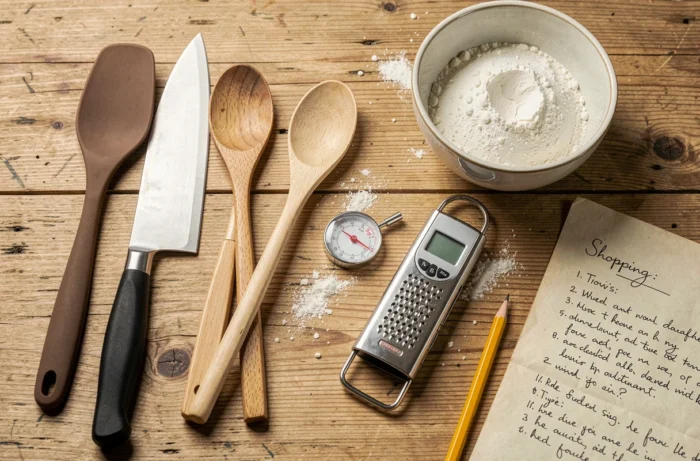
Beyond pots and pans, a few accessories can make everyday cooking flow more smoothly. A stable cutting board (made of hardwood or thick plastic), a stainless steel mixing bowl, a sharp vegetable peeler and an offset spatula cover most cooking tasks.
Every accessory should serve a specific purpose. If you can’t think of when you’d use it during the week, it’s more likely to clutter your drawer than come in handy.
Repairability index: a factor to consider when choosing kitchen appliances
The repairability index, rated out of 10, takes into account the availability of spare parts, their cost compared with the price of a new appliance, and how easy the appliance is to dismantle. It appears on a growing number of household appliances and is a useful guide when making a purchase.
For food processors, blenders and mixers, the index is not yet mandatory across all categories. However, you can check manufacturers’ product information to see whether wear parts (blades, seals and bowls) are sold separately. An appliance whose blade or seal can be replaced in a few minutes will last considerably longer than a sealed model.
Choosing a repairable appliance often costs less over five years than buying a budget model twice. The French Ministry for Ecological Transition’s website explains manufacturers’ obligations regarding the availability of spare parts.
Choosing kitchen equipment isn’t just about ticking products off a list. It starts with what you actually cook, the type of hob you have and the tasks you repeat every evening. Three good knives, two or three pieces of cookware suited to your usual recipes, and a repairable electrical appliance will more than meet the needs of an everyday cook without cluttering the cupboards.