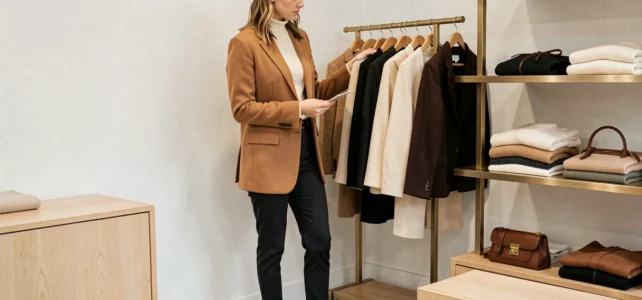
Every new school year brings the same question: what to wear to feel good without looking like you’re copying a runway show? This season, fashion trends are blending generous cuts, raw materials, and a second-hand reflex that changes the way we build a look. Here are the key points to remember for creating outfits that reflect your style.
Second-hand and stylish fashion: the reflex that redefines trends
Have you noticed that thrift stores and resale platforms occupy as much space as traditional retailers? It’s no longer a niche phenomenon. According to McKinsey’s State of Fashion 2026 report, the second-hand market is growing two to three times faster than the new market.
In Europe, this market now exceeds 42 billion euros, with a 24% increase year-on-year for clothing and footwear. In France, Germany, and the UK, second-hand accounts for between 12% and 15% of the fashion market.
Practically, this means that a vintage aviator jacket or a barrel jean found on Vinted can be the standout piece of a seasonal outfit. Searching for a trendy cut in the second-hand market is no longer a compromise; it’s a fully-fledged style choice. Those who follow fashion trends on Fashion Clubwear regularly find inspirations that pair well with both new items and thrifted pieces.
Denim, leather, and suede: the trio of materials for the season
Materials set the tone of a silhouette even before we look at the cut. This season, three textures are making a strong comeback in both women’s and men’s wardrobes.
Denim beyond the classic jean
Denim is no longer limited to five-pocket pants. It’s found in structured jackets, midi skirts, and even shirt dresses. The barrel jean, with its rounded cut at the thighs and tapered at the ankle, remains the key silhouette.
For a cohesive look, it’s better to avoid a total denim outfit from head to toe. Pair a denim piece with a smooth material (leather, fine cotton) to create a sharp visual contrast.
Smooth leather and suede: textures that structure
Smooth leather adds structure to a casual outfit. A short leather jacket worn over a basic tee transforms a simple look into a constructed silhouette. Suede, softer to the touch, works well with looser pieces: oversized jackets, A-line skirts.
Alternating smooth leather and suede in the same outfit creates a play of textures without adding extra color. It’s a useful tip when you prefer to stick to a sober palette.
Seasonal colors: khaki, cyan blue, and natural shades
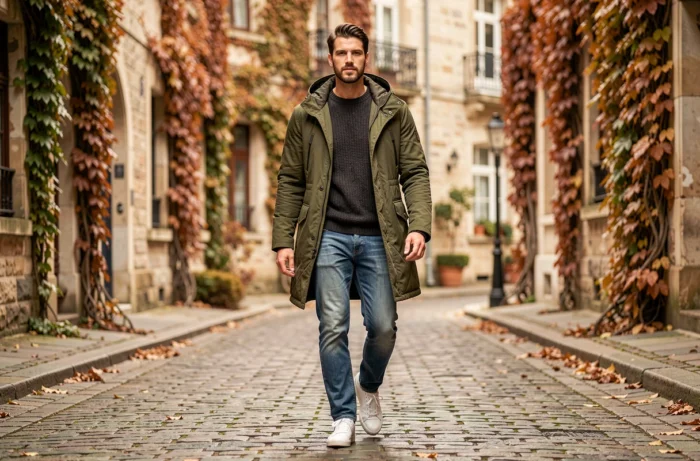
Why do certain colors prevail from one season to the next? Often because they work well with what we already own. Khaki and olive green, inspired by military aesthetics, easily combine with beige, off-white, or black.
Cyan blue made a statement on the streets during Copenhagen Fashion Week and continues to assert itself. It’s a color bright enough to energize a neutral outfit but cool enough to remain wearable daily.
- Khaki and olive green: versatile, they can be worn as cargo jackets, straight pants, or loose shirts, and work year-round.
- Cyan blue: ideal as a standout piece (a sweater, a dress) on a neutral base to avoid overload.
- Natural shades (beige, ecru, taupe): they serve as a backdrop and allow for highlighting a strong color or a marked texture.
Volumes and cuts: structuring a look without stiffening it
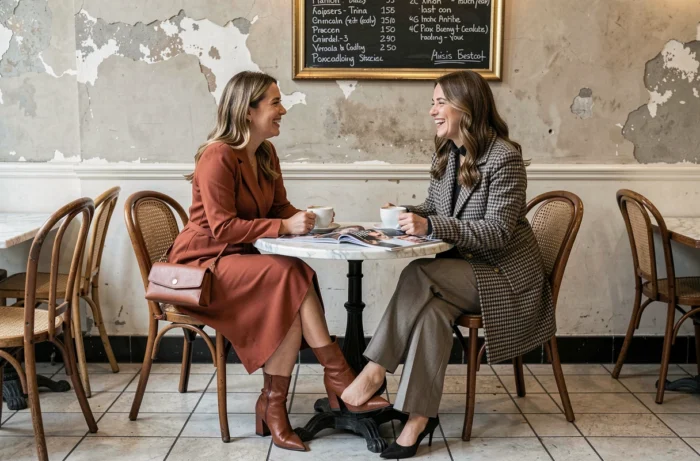
This season’s silhouettes play on the contrast between fitted pieces and loose ones. The principle is simple: a high volume calls for a fitted lower volume, and vice versa.
An oversized sweater tucked into high-waisted pants creates a visual balance. Conversely, a fitted top (t-shirt, bodysuit) pairs well with balloon pants or a flowing long skirt.
Aviator inspiration, a standout piece in the wardrobe
The aviator jacket returns with more refined finishes: supple leather, shearling collar, rethought pocket details. It’s a piece that works well over a light dress as well as with straight jeans.
A common mistake is to accumulate too many voluminous pieces. One statement element per outfit is enough to add character. If you’re wearing an oversized aviator jacket, keep the bottom simple: slim jeans or classic straight pants.
Cut-out ballerinas and detailed shoes
On the footwear front, cut-out ballerinas extend the summer trend into autumn. They lighten an outfit built around heavy materials (leather, thick denim).
Shoes with visible details (buckles, contrasting stitching, sculpted soles) add a point of interest without requiring additional accessories. It’s a simple lever to personalize a basic look.
Environmental claims: what changes for brands in 2026
When you read “eco-friendly” or “green” on a label, do you know what it really means? Since 2026, European regulations have tightened the rules around these claims. Generic terms like “ecological,” “environmentally friendly,” or “climate neutral” are now prohibited unless the brand has a recognized certification, such as the European Ecolabel.
The AGEC law also requires brands to provide progressive environmental labeling on textile products. This changes the way brands communicate about their collections.
For you, as a consumer, this means that labels are becoming more reliable. A garment that makes an environmental claim without proof can be penalized. This is an additional criterion to consider when building your seasonal wardrobe.
The fashion trends of this season are as much about cuts and materials as they are about how we shop. Mixing a thrifted piece with a well-cut new basic, playing with contrasts in textures, choosing one or two strong colors on a neutral base: a stylish look relies on a few precise choices rather than an accumulation of pieces.