The fanny pack is one of the most ambiguous accessories in air travel. Depending on the airline, it can be considered a tolerated personal item in addition to the cabin baggage, or as a second bag subject to an extra fee. This difference in treatment does not depend on a single aviation regulation, but on the commercial conditions specific to each carrier, which vary according to the fare purchased and the ground staff.
Fanny pack and security control: what scanners change
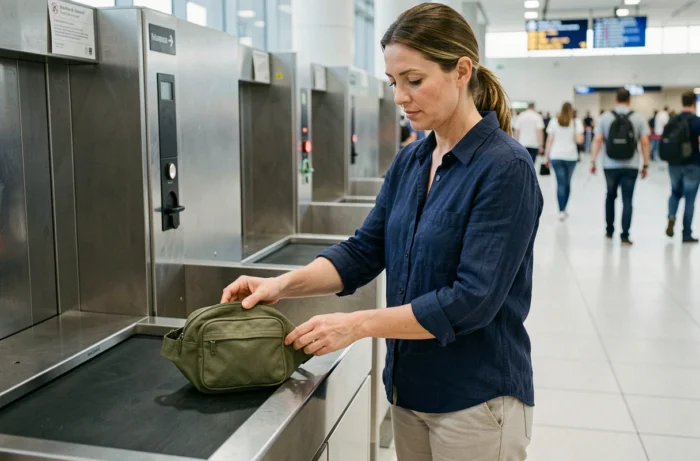
At security checkpoints, the fanny pack functions as an extension of pockets. Security agents generally ask to remove it and place it in a bin, just like a jacket or a belt.
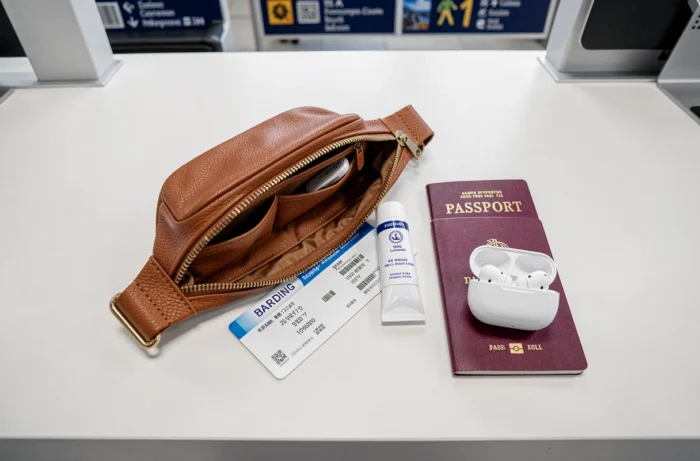
With the gradual deployment of CT scanners in some airports, the rules regarding liquids and electronic devices are evolving. A fanny pack containing a power bank or a bottle of hand sanitizer may require separate inspection. The recent trend is to empty the contents of the fanny pack into the main luggage before passing through the scanner, rather than presenting it as a separate item in a bin.
In practice, the fanny pack is not a problem for airport security. It becomes one when treated as a second bag at the time of boarding, which falls under a completely different logic: that of commercial policy.
To fully understand the rules for the fanny pack on a plane, it is essential to distinguish between security control (identical for all) and baggage control at the boarding gate (variable according to the airline and fare).

Cabin baggage policy by airline: comparative table for fanny packs
The status of the fanny pack depends on the definition that each airline gives to “personal item.” Some accept it unconditionally, while others include it in the quota of a single cabin baggage.
| Airline | Separate personal item allowed | Fanny pack tolerated in addition | Note |
|---|---|---|---|
| Ryanair (basic fare) | No | Tolerated if worn under the jacket | Recent tightening at boarding gates, especially in Dublin |
| easyJet | No | Tolerated if discreet | Only one cabin baggage allowed, any visible accessory may be contested |
| Air France | Yes (personal accessory) | Yes | No explicit mention of the fanny pack in official lists |
| North American airlines (e.g., Delta, United) | Yes (personal item) | Yes | The fanny pack easily falls into the “personal item” category |
The contrast is clear between traditional airlines and low-cost carriers. At Ryanair, any additional accessory can be charged if an agent considers it a second bag. In contrast, at Air France or major North American airlines, the fanny pack almost always passes without question.
The Ryanair case and recent tightening
Ryanair is now targeting what the airline considers “baggage hacks”: wearing a fanny pack in addition to the allowed cabin bag, or using a duty-free bag as extra storage. This tightening targets passengers with the lowest fare, who are only entitled to one small bag under the seat.
Enforcement remains uneven. A flight departing from Dublin may be more strictly controlled than a flight from a regional airport. The human factor plays as much a role as the written policy.
European regulation and the right to a free small bag
A European regulatory evolution aims to establish the right to a free “small bag” in the cabin, even on low-cost airlines. This text does not make the cabin suitcase in the hold free (this remains a commercial choice), but it legally guarantees free access to a small bag under the seat.
A fanny pack worn crossbody or at the waist can reasonably fall into this category, provided it meets the dimensions of the personal accessory. The nuance lies in the word “reasonably”: a standard-sized fanny pack (the one worn at the waist) poses no problem. An XXL model worn crossbody and filled to the brim resembles more of a small shoulder bag and will be treated as such.
What the size of the fanny pack concretely changes
Airlines do not publish specific maximum dimensions for fanny packs. Tolerance is based on a visual criterion:
- A flat fanny pack, worn at the waist or under a jacket, passes everywhere without discussion, even with the strictest low-cost carriers
- A bulky fanny pack worn crossbody, visibly inflated, is more likely to be reclassified as a small additional paid bag
- A fanny pack stored inside the main cabin baggage never counts as a separate item, regardless of the carrier
Fanny pack on a plane: scenarios to anticipate according to the fare
The ticket fare determines the leeway more than the type of airline. A Ryanair passenger who has opted for the “Priority + cabin baggage” option has two spaces (one bag under the seat, one suitcase in the hold). The fanny pack then becomes completely invisible for control.
Conversely, a ticket at the lowest fare on any European low-cost airline only allows access to one space under the seat. The fanny pack can only exist separately if it remains worn on oneself, discreetly, and does not attract attention at the gate.
- Basic low-cost fare: store the fanny pack in the main baggage before boarding to avoid any disputes
- Fare with cabin option: the fanny pack can remain visible, it will not be counted as a third item
- Traditional airline: the fanny pack is almost always accepted without question, regardless of the fare class
The most reliable strategy remains to slip the fanny pack into the main baggage at the time of boarding, then take it out once on board. This precaution eliminates any risk of extra charges, without any real discomfort during the flight.
The European regulatory framework is evolving in favor of passengers, but enforcement on the ground remains heterogeneous. Checking the general conditions of the chosen airline before each flight remains the only way to avoid an unpleasant surprise at the boarding gate.