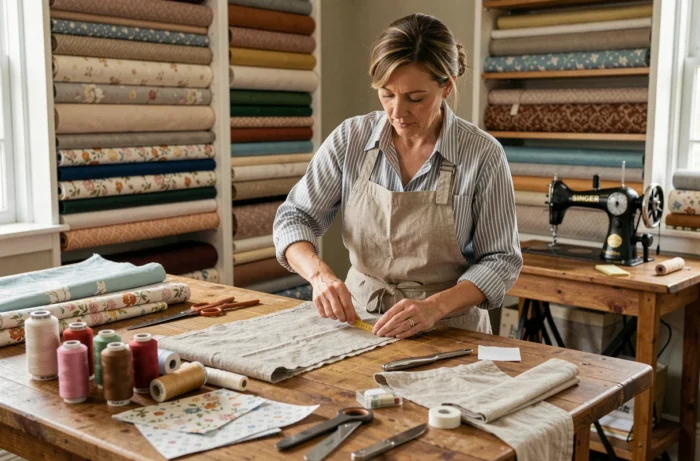
Having a seamstress come to your home for a hem or dress adjustment is convenient. The price displayed in the ad rarely corresponds to the final amount of the quote. In 2026, the very structure of home sewing rates has changed, and understanding this breakdown allows for comparing offers without making mistakes.
Breakdown of a home sewing quote: three lines instead of one
Have you noticed that a home alteration quote now includes several distinct lines? Where a seamstress once charged a single “all-inclusive” price, the quote is now divided into labor, travel, and supplies. This change is not trivial: it radically alters the way to compare two professionals.
Let’s take a concrete example. Two seamstresses offer a pant hem. The first has a lower hourly rate but adds a travel fee and charges for thread separately. The second quotes a slightly higher price, all included. Without adding up each line, it’s impossible to know which one is cheaper.
The travel fee deserves special attention. For a small alteration (sewing on a button, a simple hem), the travel fee can represent half of the final price. For a longer intervention (adjusting a lining, transforming a garment), this same fee gets diluted in the total. Grouping several alterations into a single visit remains the most straightforward way to reduce the bill.
When comparing offers, it is helpful to check the sewing rates for 2026 on Style et Chic to have an updated reading grid on these separate items.

Hourly sewing rate 2026: what explains the increase
Since the beginning of 2026, several independent seamstresses have raised their hourly rates. The increase ranges from 15 to 20 euros per hour, depending on the professionals who publicly communicate their rates.
Why this increase? Three factors are at play.
- The rise in social and tax charges for micro-entrepreneurial crafts, where contributions represent more than one-fifth of the revenue collected.
- The cost of raw materials (threads, zippers, lining fabrics) has increased in recent years, prompting seamstresses to charge for supplies separately.
- The increase in skills: more and more professionals are investing in training (sewing CAP, specialized workshops on delicate materials), which logically impacts their prices.
A low hourly rate does not guarantee a favorable final quote. A seamstress who charges less per hour but works more slowly, or who adds surcharges for technical fabrics, can end up costing more than a professional with a higher displayed rate.
Off-peak periods and calendar: the price lever that few clients use
The demand for alterations and home sewing is not steady throughout the year. Certain months concentrate urgent needs (back to school, year-end holidays, wedding season). Others, such as January-February and August-September, correspond to periods of lower activity.
During these off-peak times, seamstresses have more availability. Turnaround times shorten, and the margin for price negotiation increases. This is not about aggressive bargaining, but simply about supply and demand: a professional with gaps in her schedule would prefer to offer an adjusted rate rather than remain inactive.
Group alterations to amortize travel costs
Rather than having a seamstress come for a single pant hem, gather all the garments that need attention. A batch of three or four alterations makes the travel fee more worthwhile and puts you in a better position to request a grouped quote.
Planning your alterations during off-peak periods and grouping them is the most concrete lever to control your home sewing budget.
Textile Repair Bonus: check before paying
The Textile Repair Bonus is a scheme that helps reduce the cost of certain alterations. Not all services are eligible, and not all seamstresses participate.
Before validating a quote, ask a simple question: is the service eligible for the Textile Repair Bonus? If the seamstress indicates this on her rates, the deducted amount appears directly on the invoice. If she does not mention it, this does not necessarily mean that the alteration is not eligible, but that the professional may not have integrated the scheme into her business.
What to check on a quote
- Does the mention “eligible for Textile Repair Bonus” appear on the relevant service line?
- Is the travel fee detailed separately from the labor?
- Are supplies (thread, buttons, zipper) included or charged extra?
A clear quote, with these three visible pieces of information, protects you against unpleasant surprises at the time of payment.
Comparing home sewing offers: local workshop or independent
A tailoring workshop located in a shop and an independent seamstress who travels do not have the same cost structure. The workshop does not have a travel fee, but passes on its rent in its prices. The independent seamstress saves on the premises but charges for her trips.
For simple and frequent alterations (hems, buttons, size adjustments), the neighborhood workshop is often more economical if you can easily get there. For more complex interventions (garment transformation, lining adjustment, work on delicate materials like silk or leather), the home seamstress provides a custom service that is difficult to replicate in a standardized workshop.
The choice thus depends on the type of alteration, the frequency of your needs, and your ability to travel. Requesting a detailed quote in both cases, checking each line, remains the most reliable method to make a decision.