
The classification of pronator, supinator, or neutral remains a starting point, not an end in itself. The choice of running shoes based on foot pronation or supination relies on more refined biomechanical criteria than the simple label stuck on the box. We observe that the majority of runners do not need excessive correction and that overall comfort often takes precedence over the type of support displayed by the manufacturer.
Sole Geometry and Anti-Pronation Technologies: What Marketing Doesn’t Tell You
Pronation control devices rely on two distinct approaches. The first uses a higher density foam (dual-density) placed on the medial side of the midsole. The second relies on a rigid chassis, often made of TPU, integrated under the arch to limit inward collapse.
These two systems do not correct the stride in the same way. The dual-density foam gradually slows the pronation movement, while the rigid chassis mechanically blocks the rotation of the midfoot. For a runner with moderate pronation, the chassis may prove excessive and alter the kinetics of the posterior chain up to the knee.
We recommend testing both technologies on a treadmill in a specialized store. A detailed guide is available on the Esprit Sport website to delve into the selection criteria based on your stride type.

Foot Supination and Running Shoes: Why the Market Remains Poor
Supinator runners represent a minority. As a result, manufacturers offer almost no models dedicated to supination. The standard recommendation is to direct a supinator towards a neutral shoe with generous cushioning, which does not address the underlying mechanical issue.
A supinator loads the outside of the foot at impact and propulsion. The asymmetric wear of the outsole confirms this pattern. On a classic neutral shoe, the cushioning is centered or slightly medial, leaving the lateral area under-protected.
Some concrete tips for supinators:
- Prefer models with a wide outsole and reinforced rubber on the lateral edge to slow wear and stabilize the stance
- Look for soft cushioning without medial correction, allowing the foot to roll naturally without forcing it inward
- Consider a custom orthotic in addition, as the shoe alone does not compensate for a marked structural defect in the foot
Shoe Rotation and Stride Type: Adapting the Pair to the Session
The same runner can benefit from several types of shoes depending on the nature of the training. This approach, which specialized store experts observe daily, remains poorly documented in standard guides.
For a moderate pronator, we observe that long runs at a low pace place more demand on the pronation mechanism (muscle fatigue, relaxation of the posterior tibial). A slightly stabilized shoe is justified for these sessions. On the other hand, interval sessions on the track do not require correction: speed shortens the ground contact time and mechanically reduces the amplitude of pronation.
Building a rotation adapted to your stride involves crossing two parameters:
- The intensity and duration of the session (the longer the run, the more fatigue amplifies biomechanical imbalances)
- The terrain used (road, track, trail), as a soft-soled shoe on soft ground does not react the same way as on asphalt and can accentuate a movement of supination or pronation
- The state of muscular freshness, which varies according to the weekly training load and directly influences foot control with each stride
Drop and Pronation: An Underestimated Variable in Shoe Choice
The drop (the difference in height between heel and forefoot) alters the distribution of stress on the musculoskeletal chain. A high drop, around ten to twelve millimeters, favors a heel strike and can accentuate pronation in some runners whose eccentric control of the posterior tibial is weak.
Reducing the drop does not correct pronation, but changes the ground impact point. A lower drop shifts the impact towards the midfoot, shortening the lever arm responsible for the pronation movement. Brands like Altra now offer models with a moderate drop available in both neutral and stabilized versions (like the Altra Flow ST for runners with more pronounced pronation), proving that natural stride and support are no longer incompatible.
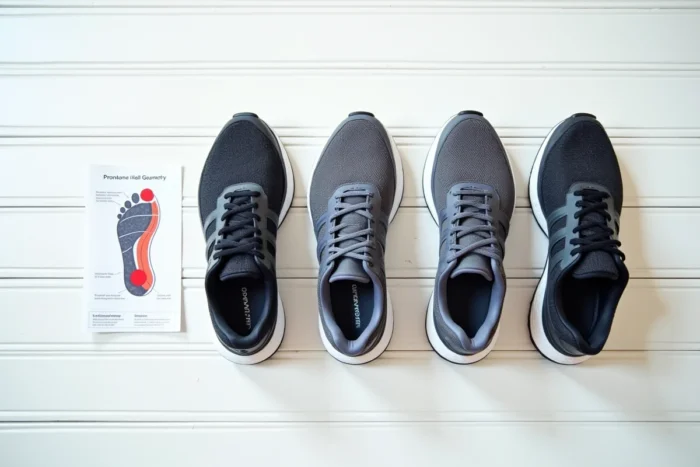
For a supinator, a low drop presents a different advantage: it reduces stress on the lateral edge of the heel by decreasing impact force at the strike. Combined with a wide toe box, this type of shoe allows the toes to spread and actively participate in stabilizing the foot.
Orthotic Insole and Running Shoe: Compatibility to Check
When a podiatrist prescribes a corrective insole, the shoe must offer sufficient internal volume to accommodate it without compressing the foot. Removing the original insole before inserting the orthotic is a reflex that many runners forget, creating an excess thickness and altering the actual drop of the shoe.
A stability shoe combined with an anti-pronation insole can lead to overcorrection. In this case, we recommend starting with a neutral model and allowing the orthotic to handle the control work alone. The podiatrist and the specialized seller must work towards the same goal, which involves communicating about the chosen model before purchase.
The choice of a running shoe based on pronation or supination should be regularly reevaluated. The stride evolves with training volume, age, weight, and any injuries. A stride analysis conducted three years ago does not necessarily reflect your current biomechanics. Plan for a reevaluation at least with each new pair.