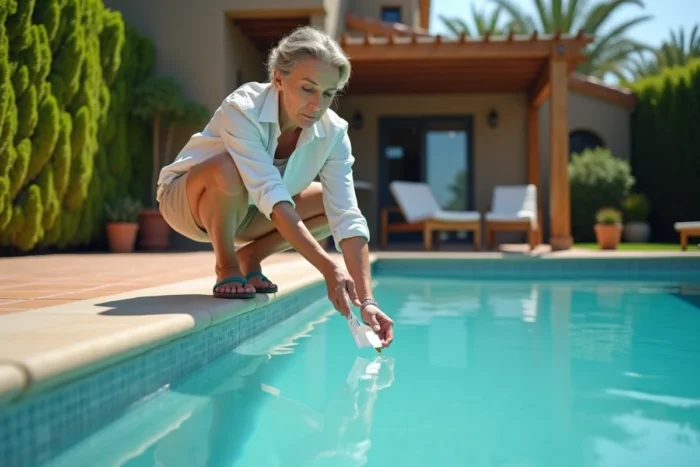
A swimming pool whose water turns green or takes on a milky appearance rarely presents a single isolated problem. Behind the color and transparency lie chemical, mechanical, and even optical parameters that interact continuously. Achieving blue and crystal-clear pool water requires understanding these interactions rather than simply multiplying corrective products.
Pool Liner and Perceived Color of Pool Water
Most guides focus on chemical treatment, but the hue of the water primarily depends on the liner installed at the bottom and on the walls. A dark gray liner gives a deep blue rendering, a white coating enhances turquoise transparency, while beige tiles pull the water towards green, even with perfect chemistry.
Several recent sources confirm this point: the liner influences the visual color of the water as much as the treatment. Sand or natural stone shades, which have become fashionable with pool staging finishes, alter perception without any chemical adjustment being able to compensate for the discrepancy. Before looking for a problem in your analyses, check if the color you are aiming for is compatible with the bottom of your pool.
To achieve blue pool water, the choice of liner remains the most underestimated lever, well before the addition of colorants or flocculants.
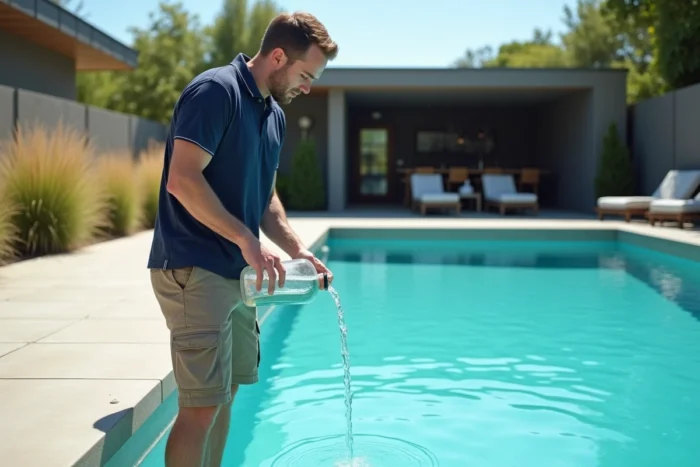
Chemical Balance of the Pool: Beyond Chlorine
The reflex when faced with cloudy water is often to increase the chlorine dose. This is a common mistake. An excess of chlorine can itself cause milky water, irritate the skin, and degrade equipment.
pH remains the parameter to monitor as a priority. A pH between 7.2 and 7.6 ensures the effectiveness of the disinfectant, regardless of the method used. Outside of this range, chlorine loses a significant part of its oxidizing power, and algae find a favorable environment.
Stabilizer: The Silent Trap
The stabilizer (cyanuric acid) protects chlorine from UV rays, but it accumulates in the water over the weeks. When its concentration becomes too high, chlorine is neutralized and no longer disinfects, even if the test strips show a correct level. Field reports vary on the exact threshold at which the blockage occurs, but the consensus places the critical zone well above the levels recommended by manufacturers of stabilized tablets.
The only reliable solution to reduce stabilizer levels is to renew a portion of the pool water. No chemical product effectively degrades it.
Alkalinity and Hardness: Two Neglected Parameters
Alkalinity (TAC) plays a buffering role on pH. If it is too low, pH fluctuates significantly from day to day, making any dosing unstable. Hardness (TH), on the other hand, influences the limestone deposits that can cloud the water. Checking these two values before acting on chlorine prevents treating symptoms without addressing the cause.
Filtration and Circulation: The Mechanical Foundation of Crystal-Clear Water
Chemistry only works if the water circulates properly. Undersized filtration or too short operating times leave dead zones where particles accumulate.
- The daily filtration duration depends on the water temperature: the warmer the water, the longer the pump must run to compensate for bacterial proliferation accelerated by heat.
- The filter (sand, glass, cartridge) must be cleaned or backwashed regularly. A clogged filter media allows fine particles responsible for cloudy appearance to pass through.
- The return jets directed towards the bottom and areas far from the skimmer improve circulation and reduce dead spots.
A well-filtered pool consumes fewer chemicals, because organic matter is mechanically captured before requiring the disinfectant. Current trends are also moving towards modernized filtration systems, coupled with variable-speed pumps that adjust flow according to actual needs.
Automation of Pool Water Treatment in 2026
Recent technical content shows a clear shift: advice is moving from manual dosing to pools controlled by automatic regulators. pH regulators, salt electrolysers, connected Redox probes, these devices continuously measure and correct water parameters.
Salt electrolysis produces chlorine directly in the circuit, without handling tablets or accumulating stabilizer. The salt is recycled in a loop, which reduces product additions and simplifies maintenance. Connected systems send alerts to smartphones when a parameter drifts, before the water becomes visibly cloudy.
This automation has an installation cost, but field reports indicate a significant reduction in chemical consumption over a full season. For owners who do not wish to test their water manually several times a week, it is a lever of comfort and reliability.
Flocculant and Clarifier: Occasional Use, Not Systematic
The flocculant aggregates particles that are too fine to be captured by the filter. The clarifier works similarly but in a gentler version. These products work, provided two rules are followed:
- Only use them after correcting the pH and verifying the proper functioning of filtration, never as a first resort.
- Adapt the type of flocculant to the filter media: some tablet flocculants are incompatible with cartridge filters and can clog them permanently.
- Suction the deposit formed at the bottom of the pool after flocculation, ideally in “drain” position to avoid sending particles back into the circuit.
The flocculant never replaces a foundational treatment. Using it every week masks a chemical imbalance or a filtration defect that will eventually lead to a more serious problem, such as algae growth resistant to chlorine.
The transparency of the water relies on the interplay between liner, chemistry, filtration, and increasingly, automation. Each link compensates for the weaknesses of the other, but none can function alone. A pool with a pH that drifts daily will not be saved by a high-performing robot, and impeccable chemical treatment will not mask a filter that has been clogged for three months.