Decree No. 87-712 of August 26, 1987 remains the reference text for distributing the maintenance costs of a hot water tank between tenant and landlord. However, a careful reading reveals gray areas that most online guides do not address, particularly regarding maintenance proof and the concept of obsolescence applied to hot water production equipment.
Maintenance Certificate and Burden of Proof in Case of Dispute
The issue of maintenance proof for the hot water tank is the most frequent point of contention during a breakdown during the lease. Decree No. 87-712 imposes regular maintenance on the tenant but does not specify in what form this obligation must be documented.
In practice, we recommend that the tenant keep all invoices for descaling, seal replacement, or purging carried out by a professional. The landlord can legitimately request these documents, and their absence works against the tenant if a dispute arises regarding the cause of a breakdown.
For a gas water heater, the situation is clearer: the decree of September 15, 2009 requires an annual inspection by a qualified professional, and the certificate issued serves as proof. The tenant must provide it to the landlord upon request. Understanding the specific terms of hot water tank maintenance in rental allows for anticipating these situations before they escalate.
For an electric water heater, no annual certificate is required by law. It is precisely this gap that fuels disputes: the landlord claims a lack of maintenance, the tenant asserts they have regularly purged the safety group, and no one can prove anything.
Regular Maintenance Actions for Electric Water Heaters: Frequency and Water Hardness
For an electric water heater, the tenant is responsible for two main actions: purging the safety group and descaling the tank.
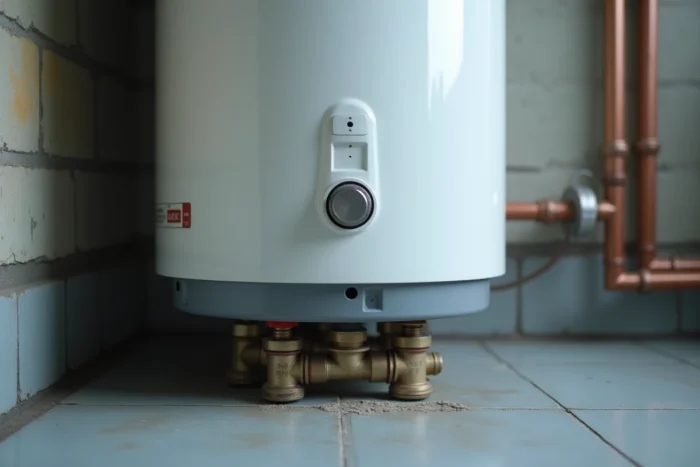
- The purging of the safety group should be done once or twice a month. This involves operating the valve to release limescale deposits and checking that the device is functioning correctly.
- A complete drain and descaling of the tank are recommended every two to three years, depending on the local water hardness. In areas where the TH significantly exceeds the average limestone threshold, this frequency should be shortened.
- The replacement of small wear parts (seals, limescale-covered heating element) also falls under tenant maintenance, as long as the intervention does not concern a structural component of the device.
We observe that the majority of premature breakdowns in electric water heaters stem from untreated limescale buildup. The heating element, buried under a layer of limescale, overheats and eventually fails. Regular descaling doubles the useful life of the heating element.
Major Repairs and Replacement of the Hot Water Tank: Landlord’s Obligations
The landlord is responsible for repairs that exceed regular maintenance. The distinguishing criterion is simple: anything related to the replacement of a major component or the restoration of the device itself falls under the landlord’s responsibility.
Specifically, this includes the replacement of a leaking tank, changing a faulty thermostat when the breakdown is not due to a maintenance issue, and of course the complete replacement of the device in case of obsolescence.
Obsolescence of the Water Heater: A Often Misapplied Criterion
The concept of obsolescence remains the most slippery legal terrain. A hot water tank has a limited lifespan, generally estimated at around ten years according to manufacturers. When the device breaks down after this period, the landlord cannot attribute the failure to the tenant, even if regular maintenance has not been impeccable.
The obsolescence grid, when attached to the lease, allows for resolution. In the absence of a grid, it is the Departmental Conciliation Commission or the judge who arbitrates. We recommend that landlords systematically attach an obsolescence grid to the rental contract to avoid these deadlocks.
Gas Water Heater: A Distinct and More Stringent Maintenance Regime
The gas water heater requires mandatory annual maintenance, unlike the electric water heater. This obligation arises from the decree of September 15, 2009, which concerns all combustion devices (boilers, gas water heaters, water heaters).
The cost of this annual visit is the tenant’s responsibility. The professional checks the burner, monitors carbon monoxide emissions, cleans the heat exchanger, and issues a maintenance certificate. This certificate must be kept for the entire duration of the lease.
In case of non-compliance with this obligation, the consequences are twofold. The insurer may invoke a lack of maintenance to limit or deny compensation in the event of a claim. The landlord may withhold part of the security deposit if the breakdown is directly related to the absence of annual maintenance.
Special Case: Tenant Recently Moved In
When a tenant moves in during the year, they must have the annual maintenance of the gas water heater completed before the end of the first year of occupancy, even if the previous occupant had it done recently. This is their own contractual responsibility, independent of the housing history.
Hot Water Tank Breakdown in Rental: Landlord’s Response Time
The law of July 6, 1989, requires the landlord to provide decent housing with a functioning hot water supply. In the event of a breakdown attributable to obsolescence or a non-tenant-related defect, the landlord must intervene within a reasonable timeframe.
No text specifies a quantified timeframe. Jurisprudence generally holds that after a few days without hot water, the tenant can formally notify the landlord by registered letter, and then refer the matter to the Departmental Conciliation Commission or the judicial court.
- First step: report the breakdown in writing (email with acknowledgment or registered letter) to establish proof of the reporting date.
- Second step: allow a reasonable timeframe for the landlord to arrange for a professional’s intervention.
- Third step: in case of prolonged inaction, refer the matter to the Conciliation Commission or initiate a rent withholding procedure with the court.
The tenant should never have the device replaced on their own initiative without written agreement from the landlord, under penalty of not obtaining reimbursement for incurred expenses.
The distribution of costs between tenant and landlord is based on a clear principle: regular maintenance on one side, structural repairs and replacement on the other. What is most often lacking is not the knowledge of this rule, but its documentation. Keeping every invoice, every certificate, and every written exchange remains the best protection for both parties.