
The fortune of Philippe de Villiers rests on a legal web that most online estimates treat as a black box. The figures that circulate – often exceeding 33 million euros – amalgamate the valuation of an associative and commercial empire with personal assets whose real contours have escaped any declarative obligation since the end of his electoral mandate.
Methodology for estimating wealth applied to an atypical profile
We observe a recurring bias in public analyses: the confusion between valuation of controlled assets and personal wealth. Philippe de Villiers does not appear in any rankings such as Challenges or Forbes, and for good reason. Rankings of French fortunes rely on identifiable stakes in companies whose capitalization or consolidated accounts are public.
The Puy du Fou, the pivot of all estimates, is structured around a 1901 law association. An association has neither shareholders nor distributable dividends. The satellite commercial entities (accommodation, catering, merchandising, international) revolve around this structure without their complete shareholding being accessible in a consolidated manner in the commercial register.
To attempt to evaluate the fortune of Philippe de Villiers in 2026, it would be necessary to reconstruct four distinct layers: the family land in Vendée, direct or indirect stakes in the commercial subsidiaries of Puy du Fou, the copyright from his works, and any financial or real estate investments outside the Vendée area. No public source covers these four layers simultaneously.
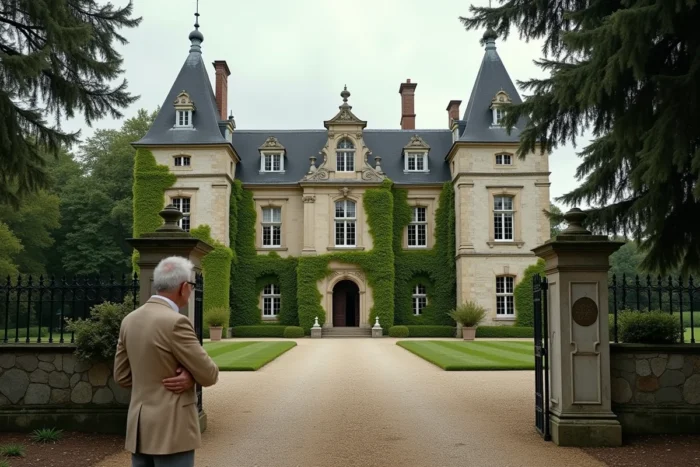
Villiers’ wealth and taxation: what the IFI no longer captures
The debate about the supposedly unpaid wealth tax (ISF) by Philippe de Villiers occupies a lot of media space. It deserves a technical reframing.
The ISF included professional assets beyond a certain threshold, but provided for an exemption for professional assets for executives performing an operational role. If de Villiers met the criteria for effective management of a commercial structure of the Puy du Fou group, the exemption was legally founded, not fraudulent.
Since the replacement of the ISF by the IFI, only net real estate wealth falls within the scope. Shares in companies, copyright, cash, and financial investments are excluded. A recent senatorial report on the taxation of high wealth highlights that this restriction has significantly degraded the administrative knowledge of very large fortunes in France.
The practical consequences for estimating Villiers’ wealth are direct:
- The Vendée land (family castle, land) remains in principle within the scope of the IFI, but the valuation of rural properties in Vendée remains modest compared to Parisian or coastal real estate
- Shares in the commercial structures of Puy du Fou escape the IFI, rendering the most significant component of the wealth invisible
- Copyrights, which according to several analyses constitute a regular source of income, are not captured by any wealth tax
Copyright and editorial income of Philippe de Villiers
The works of Philippe de Villiers regularly sell in high print runs for the French political and historical essay market. This income stream is often mentioned in passing, rarely quantified rigorously.
Copyrights constitute a fully-fledged asset, valuably based on the remaining duration of the exploitation of the works. A catalog of several dozen titles, some of which are bestsellers, generates recurring flows for decades, including after the author’s death through transmission to heirs.
This item is even more relevant as copyrights benefit in France from a specific tax regime (BNC with deduction or micro-BNC regime), more favorable than the capital income regime. In a global wealth strategy, maximizing the share of income in the form of copyrights rather than dividends or executive remuneration presents a structural tax advantage.
Transmission and family governance around Puy du Fou
The wealth question is not limited to a stock of assets at a given moment. The governance of Puy du Fou involves several members of the Villiers family, including his son Nicolas, who holds operational management positions.
This configuration raises the question of transmission. Mechanisms like the Dutreil pact allow in France for the transfer of company shares with a very significant tax deduction, provided that conservation and management commitments are respected. Recent case law and legislative adjustments in 2026 have tightened certain eligibility conditions, but the mechanism remains the main tool for transmitting family businesses.
For a structure as intertwined as Puy du Fou, with its associative and commercial layers, succession planning becomes a legal exercise in its own right. The issue is not only fiscal: it is about ensuring the sustainability of a governance model where associative volunteering and commercial management coexist.

Reliability of online estimates of Philippe de Villiers’ fortune
The amounts circulating deserve a critical look. The estimate of 33 million euros, repeated by many sites, seems to stem from old cross-references between wealth declarations of elected officials and approximate valuations of Vendée land. Some private estimates mention amounts much higher, without transparent methodology.
Three factors render these figures structurally fragile:
- The absence of public consolidated accounts for the entire Puy du Fou perimeter, which prevents any reliable valuation of stakes
- The degradation of fiscal visibility since the ISF-IFI transition, which deprives analysts of an administrative reference point
- The associative nature of the parent structure, which renders traditional valuation methods by multiples of results inoperative
Stating a precise figure is more a matter of speculation than wealth analysis. The real wealth of Philippe de Villiers remains largely opaque, not due to concealment, but because of the very nature of the legal structures that compose it. The most honest estimates are those that acknowledge this uncertainty rather than presenting a reassuring amount.