
The Pickup network and the Colissimo service share La Poste’s infrastructure, but their operational logics diverge on points that most online help guides do not detail. Understanding these discrepancies allows for choosing the appropriate pickup method based on the actual flow of parcels, not just perceived convenience.
Pickup locker hours: a nearly 24/7 availability outside metropolitan areas
Pickup lockers display opening hours from 00:01 to 23:59, seven days a week. This format is not limited to major Parisian train stations: locations in medium-sized towns like Baugé-en-Anjou, Montluel, or Gujan-Mestras apply the same schedule.
This availability changes the game for professionals managing returns or receptions outside commercial hours. A locker accessible at any time removes the coordination constraint with the hours of a relay merchant, often limited to daytime and closed on Sundays.
We observe that this nearly continuous coverage remains little known among e-commerce shippers, who continue to offer the relay merchant by default. To better understand the differences between Pickup relay and Colissimo locker, one must first consider actual availability, not just geographical proximity.
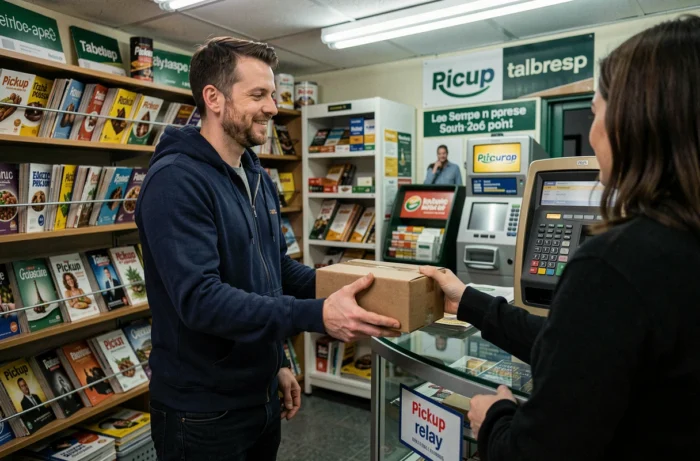
Merchant Pickup relay: volume constraints and redirect protocol
A Pickup relay is a local business (tobacco press, supermarket, bookstore) that agrees to temporarily store parcels. The storage capacity directly depends on the available space in the back room. During peak periods (sales, holidays), some relays become saturated and refuse new deliveries.
The standard holding period at a relay is fourteen calendar days. After this period, the parcel is returned to the sender. If the relay temporarily closes (vacation, renovations), a redirect protocol to another point or post office is triggered, but it extends the availability period by several days.
This redirect is not transparent for the recipient: the availability notification may arrive while the parcel is already in transit to another point. We recommend systematically checking the Colissimo tracking rather than relying solely on the initial SMS.
Dimensions and weight accepted at relays
- Pickup relays generally accept parcels weighing no more than thirty kilograms, but the actual limit varies depending on the merchant and their equipment
- Bulky items (length over one meter) are often refused due to lack of suitable storage space
- Some specialized relays (supermarkets, DIY stores) tolerate larger volumes than urban tobacco presses
Colissimo locker and automatic locker: capacity, compartment size, and limits
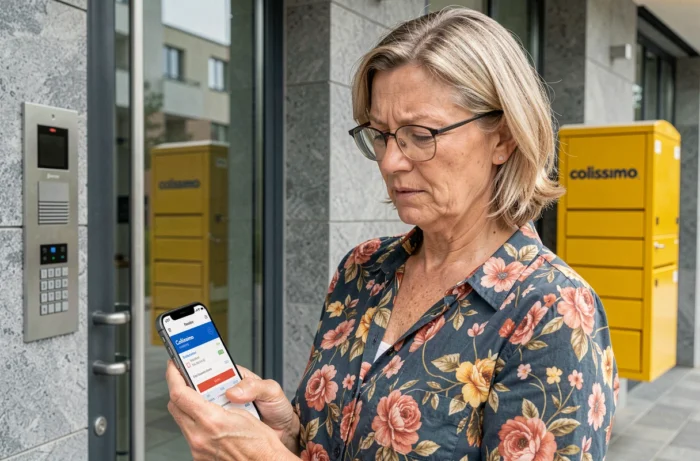
Pickup lockers operate with individual locked compartments. The recipient receives a unique code via SMS or notification, which they enter on the locker’s touchscreen to open the assigned compartment.
Each locker has compartments of different sizes (small, medium, large). The assignment is done automatically based on the declared dimensions of the parcel. If no compartment of the right size is available at the time of delivery, the parcel is redirected to the nearest alternative pickup point.
This point is often overlooked: the locker is not an absolute guarantee of availability. In densely populated areas with high e-commerce traffic, large compartments fill up quickly. Professional shippers who set the locker as the default option must plan for a fallback point in their Colissimo configuration.
Holding period in lockers
The holding period in Pickup lockers is shorter than in merchant relays. After this period, the parcel is automatically returned. Quickly retrieving one’s parcel is imperative with a locker, which suits responsive recipients but penalizes those who travel or forget notifications.
Pickup network coverage in France: 7,500 lockers and 166,000 points in Europe
La Poste communicates about a Pickup network reaching 166,000 pickup points in Europe, including 60,000 lockers. In France, the network exceeds 7,500 lockers. This growth reflects a clear strategy: to complement the network of merchant relays with automats that absorb volume peaks without mobilizing labor.
For e-commerce merchants, this densification modifies logistical settings. Offering lockers as a delivery option is no longer merely an urban niche service. The network now covers peri-urban and rural areas, expanding the base of eligible recipients.
Choosing between relay and locker based on recipient profile
- A recipient with standard office hours benefits from prioritizing the locker, accessible in the evening and on weekends without depending on a merchant
- A recipient receiving bulky or heavy parcels should opt for a merchant relay with suitable storage space
- A professional shipper managing a high volume of returns must configure a systematic fallback point to avoid delivery failures at a saturated locker
The choice between relay or locker is not just a matter of comfort preference: it depends on the parcel size, the recipient’s responsiveness, and the actual capacity of the pickup point. Setting these options in advance, on the sender’s side, reduces delivery failure rates and unnecessary returns to the warehouse.