
Companies hiring in 2024 are no longer looking for the same profiles as they were two years ago. Generative artificial intelligence is reshuffling the deck, hybrid work is altering retention policies, and supply chains are facing threats that go beyond logistics. These business trends are not abstract predictions: they are already transforming the daily management of teams, costs, and sales.
Cross-functional skills: what generative AI is changing in recruitment
Have you noticed that job postings increasingly mention “problem-solving” or “adaptability”? This shift has a concrete explanation. As AI takes over repetitive tasks, companies are redirecting their searches towards human skills.
The Global Talent Trends report published by LinkedIn in October 2024 confirms this shift. The most sought-after profiles combine collaboration, adaptability, and analytical ability, rather than just mastery of a technical tool. For employees, this means that ongoing training in cross-functional skills is becoming a career lever.
Specifically, a company in the administrative management sector that automates invoice processing through AI software does not eliminate the accountant’s position. It expects this accountant to interpret detected anomalies, communicate with suppliers, and suggest process adjustments.
The job remains, but its center of gravity shifts. Those who wish to delve deeper into these changes can explore Les Voix du Business online, where these topics are regularly analyzed by industry professionals.

Hybrid work and talent retention: data versus intuition
The debate about returning to the office has long revolved around productivity. Leaders feared a drop in performance, while employees defended their flexibility. In 2024, a study published in the journal Nature provides a measured response: hybrid work does not result in a significant decrease in productivity.
The study compared employees working two days a week from home with those fully on-site. No statistically significant difference in performance was noted. The hybrid group, however, showed lower staff turnover.
This last point changes the perspective. The question is no longer “should we call employees back to the office?”, but “which organizational mode retains talent best?”. In a tight labor market, attendance policy becomes a retention tool, not just a logistical choice.
What this implies for team management
Companies that impose a full return to the office without operational justification risk increased turnover. In contrast, those that structure the hybrid mode (common presence days, team rituals, adapted tracking tools) achieve the best of both configurations.
- Define two or three days of collective presence per week to preserve spontaneous collaboration
- Measure retention by team rather than just individual productivity to assess the real impact of the hybrid mode
- Train managers in remote management, a skill distinct from in-person management
Supply chain cybersecurity: a costly blind spot
When we talk about the supply chain, we think of transport, inventory, and deadlines. In 2024, an additional risk emerges in market studies: cyberattacks targeting suppliers and subcontractors.
The mechanism is simple. Rather than attacking a well-protected large company directly, hackers target a smaller, less equipped supplier. Once infiltrated, they move up the chain. The cost for affected companies far exceeds any potential ransom: production stoppage, loss of customer data, impact on sales.
Why this risk also concerns SMEs
An SME in the clothing sector that outsources its logistics to a provider can find itself paralyzed if that provider suffers an attack. Consumers, however, do not distinguish technical responsibility: they see a brand that no longer delivers.
Consequently, cybersecurity spending is increasing, but security audits of business partners remain rare in small organizations. Integrating a cybersecurity aspect into supplier contracts is no longer reserved for large corporations.
AI and professional events: large-scale personalization
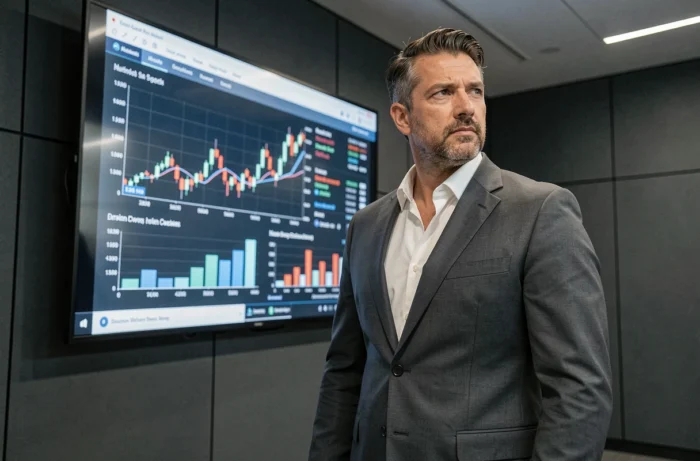
Trade shows, conferences, and professional events have not disappeared with the rise of digital. They are transforming. AI now allows for the personalization of participant experiences in advance: tailored conference recommendations based on profiles, targeted connections between exhibitors and visitors, real-time flow analysis.
For organizers, the impact is measured on two axes. The first concerns engagement: a participant who receives a program tailored to their sector stays longer and returns the following year. The second concerns costs: automating the exhibitor-visitor matching reduces the need for reception staff and optimizes space layout.
- Event platforms integrate recommendation algorithms similar to those in e-commerce
- The data collected during a trade show directly feeds post-event sales strategies
- Organizers measure return on investment per participant, rather than just total visitor numbers
The business trends of 2024 share a common thread: decisions are now made based on measured data rather than intuition. Whether for recruiting, organizing work, securing partners, or hosting an event, companies that structure their approach around verifiable facts gain a lasting advantage in their market.