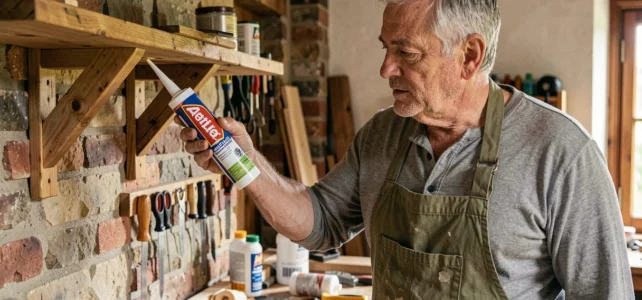
The Pattex Montage Classic adhesive is frequently mentioned by DIY enthusiasts for fixing items without drilling. Produced by Henkel, it is sold in a cartridge and promises high adhesion on a wide range of materials.
The market for mounting adhesives has evolved in recent years, with a marked shift towards solvent-free, water-based, or hybrid polymer formulations. The Montage Classic, however, retains a solvent-based formula that distinguishes it from the brand’s newer lines. Understanding what this implies in terms of use, performance, and limitations helps to place this product in its real context.
Solvent-based formulation: what it changes for bonding
The Pattex Montage Classic relies on a formula containing organic solvents. This technical choice gives it a quick initial grab and strong adhesion on non-porous surfaces such as metal, rigid PVC, or certain plastics. Water-based adhesives sometimes struggle on these substrates because water cannot evaporate through an impermeable material.
On the other hand, the presence of solvent has direct consequences. The odor during application is significantly more pronounced than with the recent “No Nails No Screws” ranges, which are systematically solvent-free. Working in a poorly ventilated room becomes uncomfortable, even inadvisable for prolonged sessions. Henkel’s technical data sheets also recommend adequate ventilation during application and drying.
A test of the Pattex Montage Classic adhesive highlights this ability to bond on mixed substrates but also emphasizes that the preparation of the substrate largely conditions the final result. This point is often underestimated in public reviews.
Substrate preparation: the factor that reviews overlook
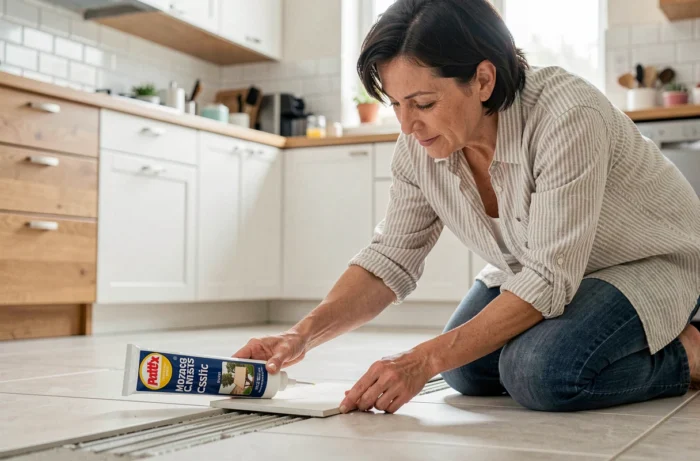
The majority of negative feedback on mounting adhesives (across all brands) share a common point: the surface was not properly prepared before bonding. Pattex’s detailed technical data sheets emphasize several prerequisites that, if not met, compromise the entire operation.
- The substrate must be clean, dry, and free of dust, grease, or flaking paint residues. A simple wipe with a damp cloth is not always sufficient on an old wall or very porous raw wood.
- On highly absorbent materials (bare plaster, cellular concrete), prior saturation of the substrate with a primer significantly improves adhesion. Without this, the substrate “sucks” the binder from the adhesive before polymerization is complete.
- Painted surfaces with glossy oil-based paint or smooth varnish must be lightly sanded to create micro-roughness. The adhesive adheres to the substrate, not to the paint film that could peel off itself.
The failure of bonding often comes more from the substrate than from the product. This reality explains part of the contradictory reviews found online, where the same product receives diametrically opposed evaluations depending on the conditions of use.
Pattex Montage Classic and compatible materials: where it excels, where it disappoints
The Montage Classic is marketed as versatile, compatible with most common materials in DIY. In practice, results vary.
Surfaces where adhesion is reliable
Solid wood, concrete, brick, metal, and rigid PVC are the substrates on which this adhesive performs best. For fixing skirting boards, corner strips, decorative elements, or panels on a wall in good condition, the bond remains stable over time indoors.
Problematic surfaces
Field feedback diverges on certain flexible plastics and expanded polystyrene. The solvent-based formula can attack some sensitive materials, causing deformation or partial dissolution of the surface. For polystyrene, it is better to opt for a solvent-free mounting adhesive, such as the water-based or Flextec range from Pattex.
On outdoor substrates exposed to constant moisture, the Montage Classic is not designed to withstand the elements. Henkel offers other references specifically formulated for outdoor use and water resistance.
Drying and final hold: what to expect
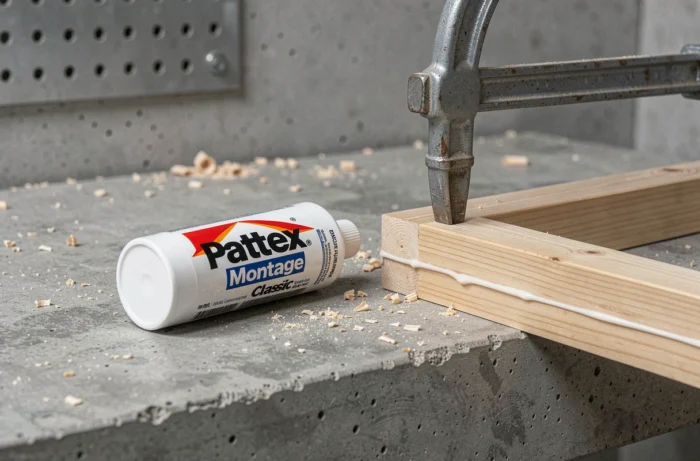
The drying of Pattex Montage Classic occurs through the evaporation of solvents. The initial grab is quick, allowing for positioning of elements without having to hold them for long minutes. However, pressure maintenance (adhesive tape, clamps, wedges) is still recommended during the first hours to ensure proper contact.
Final resistance is only achieved after complete drying, which depends on the thickness of the applied bead, the porosity of the substrate, and the ventilation of the room. On a non-porous substrate on both sides (metal on glass, for example), drying can take much longer, as the solvent can only escape through the edges of the joint.
Applying the adhesive in spaced beads rather than a full layer helps reduce drying time and improve hold. The technical data sheets recommend parallel beads or regular dots rather than a uniform spread.
Pattex Montage Classic versus solvent-free alternatives
The European market for mounting adhesives is evolving towards water-based or hybrid polymer Flextec formulations. These newer adhesives meet increasing environmental constraints and a demand from consumers for less odorous, safer indoor products.
The Montage Classic retains an advantage on non-porous substrates due to its solvent-based formula. However, for common indoor use (wall mounting, decoration, small assemblies), solvent-free adhesives now offer comparable performance with superior ease of use.
- Solvent-free adhesives do not emit any notable odor and do not require special ventilation.
- They are compatible with polystyrene and foams sensitive to solvents.
- Their cleanup is done with water before drying, whereas the Montage Classic requires a solvent like white spirit to remove excess.
The choice between solvent-based and solvent-free formulations depends on the intended substrate. On metal or PVC indoors, the Classic remains relevant. On plaster, wood, or porous materials, water-based alternatives perform just as well with fewer constraints.
The Pattex Montage Classic remains a functional product for targeted uses, provided that surface preparation is respected and the right application context is chosen. Its positioning has diminished against solvent-free ranges, but it has not lost its purpose on substrates where water-based formulations reach their limits.